
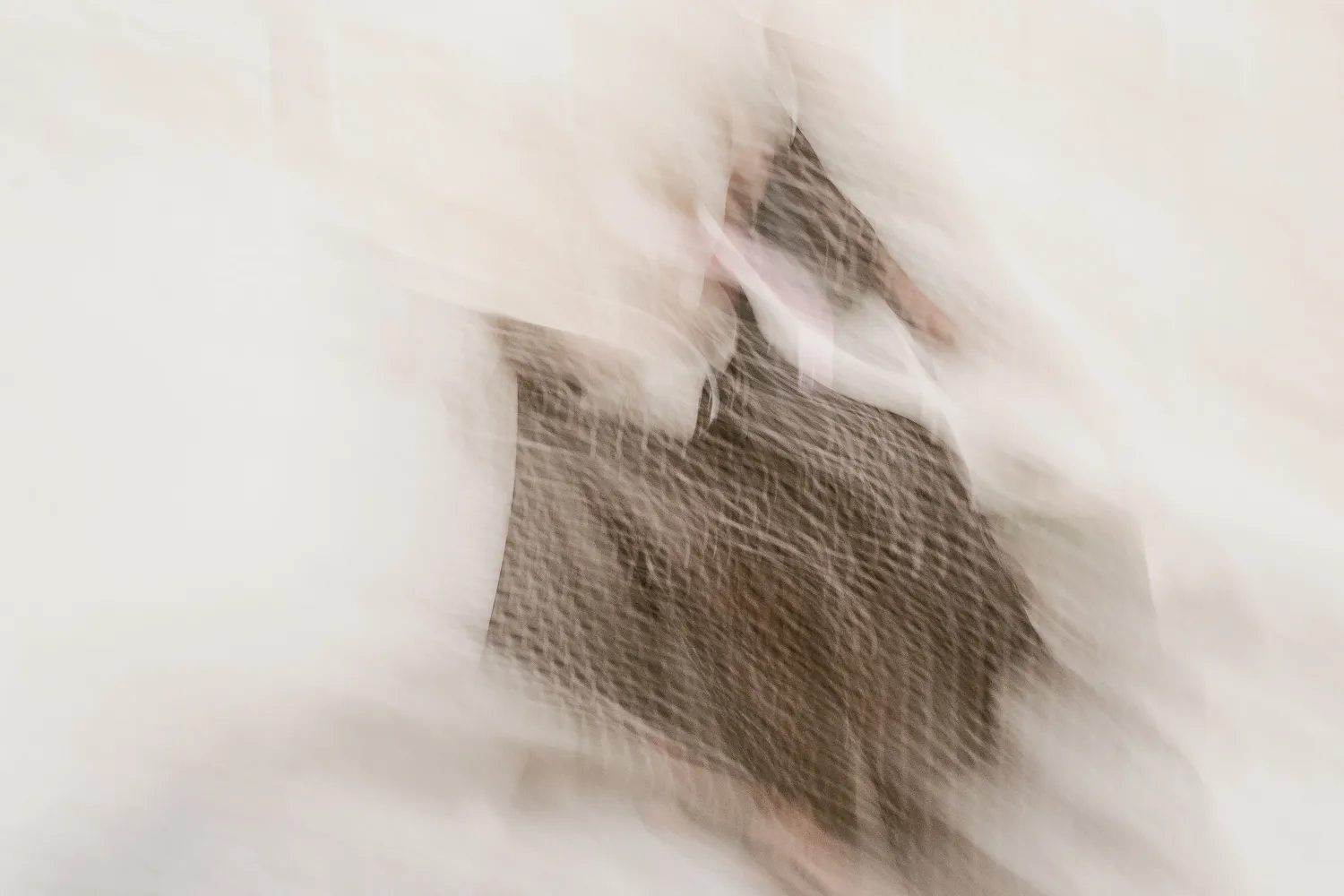
Is it really possible to take portraits without a face being in focus?
This question has been on my mind for some time ...
Abstract portrait photography with Intentional Camera Movement seemed to be a contradiction in terms. But inspired by the encounters at the Rencontre de la Photographie in Arles this year, I dared to try.
My dear Photography friend Susanne Bartels and I visited an exhibition in an enchanting little chapel on one day of our visit to the Rencontre and suddenly an idea came to me.
I asked her if she would like to do a little experiment 😉.
What emerged was more than a classic portrait:
It was the visualisation of a presence - fleeting, intuitive and deeply human.
In this article, I share this experience of an ICM portrait session and would like to sharpen your perception of why full-body shots in particular open up a new dimension of human portrayal and can also be possible with the ICM technique.
What characterises abstract portraits?
Artistic portrait photography breaks away from the pure documentation of a face. Whereas classic shots focus on sharpness, recognisable expressions, and the „windows to the soul“, this approach takes a different path:
- Essence instead of details
Not the appearance, but the being becomes visible - Emotion over identity
The mood of an encounter, not the identification - Perceiving the invisible
The aura, the energy, how someone occupies a space
The ICM technique (Intentional Camera Movement) makes this form possible. The deliberate camera movement during the exposure dissolves contours and creates space for interpretation - exactly where classic photography fixes.

Why full body portraits?
People and their environment
My experiment deliberately focussed not on facial shots, but on the whole body.
Why? Because the entire body speaks a language that is often underestimated.
Making presence visible
A person takes up space. They move through it, interact with light and architecture and leave a trace of their presence. ICM makes precisely this presence in space tangible:
- Posture as an expression
How someone stands, walks, moves - that tells more than facial expressions - Movement becomes visible
The flow of the moment instead of a frozen instant - Merging with the environment
The person is perceived as part of the whole - Energy and aura
The invisible becomes tangible
In the chapel, surrounded by sacred architecture and special light, the presence of my friend became visible in a way that would not have been possible with classical focus.
My experiment: ICM portraits in the chapel
The setting
The small chapel as an exhibition space provided the perfect stage. The sacred space with its special atmosphere, the incident light and the minimalist architecture created a dialogue between people and place.
The process
Inspired by the encounters at the Rencontre, where I had already experienced the power of ICM for architectural and natural motifs, it was very exciting to experiment: Does it also work with people?
A spontaneous experiment - 15 minutes, one place
It is important for me to mention this:
The whole thing was completely spontaneous. We had no elaborate planning, no well thought-out concept - just the curiosity and courage to simply give it a go. All the shots were taken in just 15 minutes, in a single place in the chapel. My girlfriend moved around in this confined space and I experimented with different camera movements.
For an extensive portrait session, you would of course allow considerably more time, use different locations within the room, experiment with different light sources and thus create more varied images. However, it is precisely the spontaneity and time constraints of this experiment that show:
Abstract portrait photography can emerge spontaneously and live from the intuition of the moment. This experiment proves that.
Of course, more time, different locations and settings would be needed for more varied, diverse results - but the artistic approach also works in 15 minutes in a single place.
The challenge:
- Create trust
My girlfriend had to get involved in the experiment - Follow your intuition
When does it move? When do I move the camera? - Letting go
No control over the result - pure presence
What has been created
The pictures don't show who my friend is, but how she is. Her presence becomes tangible - not through recognisable facial features, but through:
- The Kind, how their body interacts with the light
- The Track their movement through space
- The Merger of man and architecture
- The Feeling a fleeting encounter
This form does not document - it remembers.

The philosophy behind it
The transience of the encounter
Every encounter with a person is unique and fleeting. No two moments are the same.
Artistic portrait photography with ICM brings precisely this transience to life:
- The person literally “disappears” in the picture, while at the same time being present
- The presence remains as a feeling, not as a sharp image
- This is how we perceive encounters in memory - emotionally coloured, not documentary
Intuitive perception
This approach challenges and encourages the viewer's intuitive perception. There is no preconceived interpretation. Everyone sees something different, feels something different - just as everyone perceives a person differently in real life.
Respect and dignity
There is a special respect in this way of working:
- No objectification
The person is not being „detained“ or exhibited - Protection of identity
The essence remains, privacy is preserved - Preserve vitality
The human being remains in flux, not frozen - Uniqueness without identification
Recognisably unique, but not identifiable

Technology: How does ICM work in humans?
Basic settings
For abstract portrait photography with ICM you need:
- Exposure time1/15 to 1 second (depending on the desired effect)
- ISOModerate (100-400) to allow longer exposure times
- ApertureDepending on the light, often f/8-f/16
- MovementConscious camera movement during exposure
Special features for full-body images
Capturing the spatial relationship of an entire body requires:
- Larger movement area
More design options - Light and shadow
Distributed over the whole body - Interaction with architecture
Man as part of the space - The trail of movement
The path becomes a design element
The dialogue between photographer and model
This way of working is not a one-sided act.
It needs:
- Communication
The model must understand what it is about - Trust
Embrace the unknown - Intuition
Both must follow the moment - Patience
Not every shot is successful - that's part of the process
hat distinguishes artistic portraits from classic portraits?
| Classic | Abstract with ICM |
| Shows who someone is | Shows like someone is |
| Focus on the face and facial expressions | Focus on body language and presence |
| Documents identity | Reminiscent of encounter |
| Sharpness as a quality feature | Motion blur as an artistic medium |
| Person isolated | Person merges with the space |
| Objective reproduction | Subjective perception invited |
ICM portraits are not a “better or worse” form of portrait - they are a different way of honouring a person and their charisma.
From question to conviction
My initial scepticism - “Can you really take portraits with ICM?” - has turned into conviction.
Yes, you can!
But these are portraits of a different kind.
This way of working shows:
- Not the face, but the charisma
- Not the façade, but the essence
- Not the frozen moment, but the flow of the moment
The uniqueness of every encounter
Each of these pictures is absolutely unique - just like every encounter with a person.
Abstract portrait photography reminds us of this:
- We can never grasp the “whole” of a person
- Our perception is always subjective
- Encounters are fleeting and valuable
- Presence is more than physical presence
Trust in intuition
The process has taught me to trust my intuition even more. Not every picture is “successful” in the technical sense - but every picture is authentic. It shows the moment, how the model felt and how I felt at that moment.

Tips for your own experiments
1. choose the right place
Spaces full of character - sacred places, old buildings, galleries - are perfect for this type of photography.
2. communicate your vision
Explain to the model that it is not about a “perfect” image, but about capturing a feeling, an atmosphere.
3. experiment with movement
- Only the model moves
- Only the camera moves
- Both move simultaneously
Each variant creates different effects.
4. use the light consciously
Light is even more important with ICM. It traces the movement and creates the atmosphere - watch out for reflections that can be distracting
5. let go
You will not be able to fully control the result.
That is the core of ICM - and that is exactly what makes it so authentic.
A new form of portrait
Abstract portrait photography with ICM is more than just a technique - it is a philosophy. It invites us to think differently about encounters:
- What do we really perceive when we meet a person?
- Is it the sharp image or the feeling of presence?
- Can we understand a person better if we feel their essence instead of analysing their details?
My experiment in the chapel showed me that artistic portrait photography can liberate - both the person being photographed and the photographer.
It creates space for interpretation, for intuition, for the conscious experience of the fleeting moment.
Perhaps this is the most honest form: recognising that we can never grasp the whole - and appreciating the presence in the room
than sufficient,
as valuable,
as art.
If you now feel like experimenting yourself, then I wish you lots of fun and success!
Has this article sparked your curiosity? Would you like to experience what it's like not to be „pictured,“ but to be „felt“ in your essence?
How does it feel to capture your presence in space in this unique, artistic way?
Then I look forward to hearing from you
- Let's create your very own personal ICM portrait together.

FAQ: Frequently asked questions about ICM portraits
Can you really take portraits with ICM?
Yes, it works particularly well with full-body shots. Instead of focussing on the face, you capture the presence and essence of the person.
Which camera settings do I need?
Longer exposure times (1/15 - 1 second), moderate ISO (100-400) and deliberate camera movement during the exposure are the basis.
What is the difference to classic portraits?
Classic portraits focus on sharpness and recognisable details. ICM portraits show the essence and emotional quality of an encounter.
Does the model have to move?
Not necessarily. You can also move the camera while the model is standing still. Or you can both move. Experiment!
How do I explain the idea to my model?
Explain that it is not about a recognisable image, but about the feeling of the encounter. Show sample images and emphasise that the person will not be “recognisable”.